
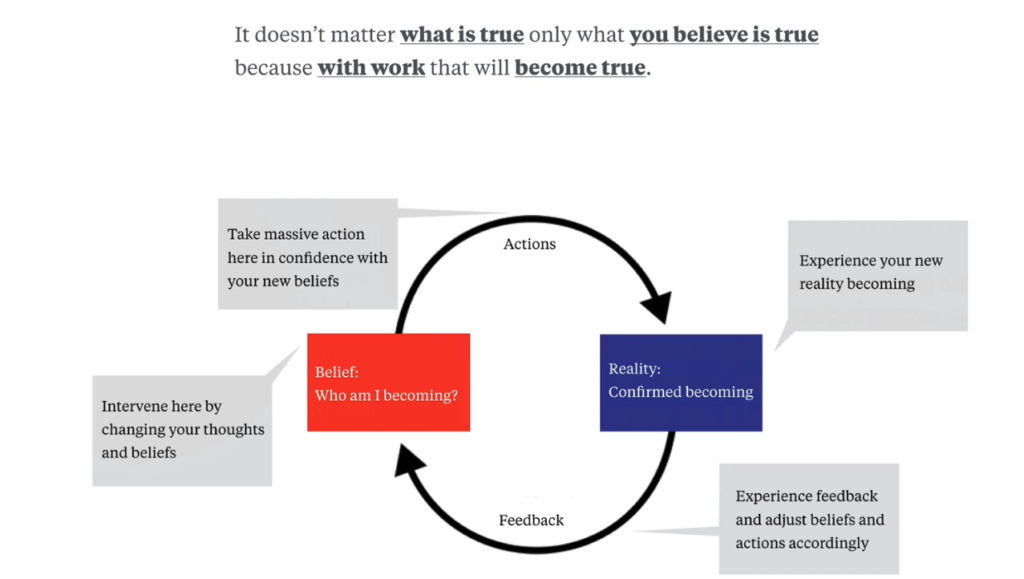
Most of us believe that reality determines our beliefs.
If we fail in business, we start believing we are not good at business.
If we struggle to exercise, we start believing we are lazy.
If we repeatedly procrastinate, we start believing we lack discipline.
But the diagram above presents a different and powerful idea:
Your beliefs influence your actions. Your actions create your reality. Your reality gives you feedback. And that feedback shapes your future beliefs and actions.
This creates a continuous loop:
Belief → Action → Reality → Feedback → Updated Belief → New Action
Understanding this loop can help us change our health, career, business, and life.
Everything Starts With Belief
The first question in the diagram is:
“Who am I becoming?”
The beliefs you hold about yourself influence the actions you are willing to take.
Imagine two people who want to become entrepreneurs.
The first person believes:
“I don’t know enough to start a business.”
Because of this belief, he spends months watching videos, reading books, researching business ideas, and taking courses.
He keeps learning.
But he never talks to customers.
He never creates an offer.
He never tries to sell anything.
One year later, he still doesn’t have a business.
Now reality gives him feedback.
He thinks:
“See? I haven’t achieved anything. I’m still not ready.”
His reality strengthens his original belief.
The cycle repeats.
This is how beliefs can trap us.
Change the Belief, and the Action Changes
Now imagine another person.
He believes:
“I don’t need to know everything before starting. I can learn by taking action.”
Because of this belief, his behavior changes.
He talks to ten potential customers.
He discovers a problem.
He creates a simple solution.
He tries to sell it.
Most people reject him.
But one person agrees to pay ₹1,000.
The money itself isn’t the most important thing.
The important thing is that he has created evidence.
His reality now tells him:
“Someone paid me because I solved a problem.”
That experience changes his belief.
He starts believing:
“Maybe I can become an entrepreneur.”
That stronger belief leads to more action.
More action creates more experience.
More experience develops better skills.
Better skills produce better results.
The positive loop begins.
The Same Principle Applies to Health
Imagine someone who has not exercised consistently for several years.
He believes:
“I’m lazy. I can’t stay consistent.”
Because of this belief, he doesn’t exercise.
He spends his evenings watching videos and scrolling social media.
Months pass.
His health gets worse.
Now he looks at his reality and says:
“See? I’m unhealthy and undisciplined.”
Once again:
Belief → Action → Reality → Stronger Negative Belief
But imagine that he changes his belief.
Instead of telling himself:
“I’m going to completely transform my body.”
He chooses a smaller and more believable thought:
“I can exercise for 20 minutes today.”
He completes one workout.
The next day, he does it again.
Then again.
After 30 days, something important has changed.
He doesn’t just have motivation.
He has evidence.
He has completed 30 workouts.
Now he starts thinking:
“Maybe I am someone who can exercise consistently.”
His actions have changed his reality.
And his new reality has started changing his identity.
Belief Alone Is Not Enough
This concept does not mean that simply believing something will magically make it true.
You cannot sit at home and believe:
“I will become a successful entrepreneur.”
You cannot repeat:
“I will become healthy.”
You cannot visualize becoming wealthy without creating value, developing skills, solving problems, and taking action.
The real formula is:
Belief + Action + Feedback + Adjustment = Progress
Beliefs are powerful because they influence behavior.
But action is what allows reality to change.
Action Creates Evidence, and Evidence Creates Confidence
Many people are waiting for confidence before taking action.
They think:
“When I become confident, I will start.”
But confidence often works in the opposite direction.
You take action.
You survive failure.
You learn something.
You improve.
You take action again.
Eventually, you produce results.
Those results become evidence.
And evidence creates confidence.
Imagine someone who is afraid of creating content.
He believes:
“People will judge me.”
So he doesn’t publish anything.
Because he never publishes, he never improves.
Because he never improves, he continues believing that he isn’t good enough.
But suppose he publishes one post.
Very few people read it.
Nothing terrible happens.
He publishes another.
Then another.
After publishing 100 posts, his writing improves.
People start responding.
Some people follow him.
Now his reality has changed.
His confidence is no longer based on motivational thinking.
It is based on experience.
Feedback Is What Makes the Loop Powerful
The most important part of the diagram may be feedback.
Imagine you start a health business.
You believe:
“People need my health coaching program.”
You create the program.
You try to sell it.
Nobody buys.
What should you do?
One response is:
“I’m a failure. I should quit.”
Another response is:
“I just need to believe harder and keep doing exactly the same thing.”
Both responses are mistakes.
Reality is giving you information.
Maybe you are solving the wrong problem.
Maybe your target customer doesn’t urgently need the solution.
Maybe your offer isn’t clear.
Maybe your price is wrong.
Maybe customers don’t trust you yet.
The intelligent response is to ask:
“What is reality teaching me?”
Then you adjust.
You talk to more customers.
You improve the offer.
You change the message.
You try again.
This is how progress actually happens.
The Goal Is Not Blind Belief
The statement at the top of the diagram says that what you believe can become true through work.
But this idea should not be interpreted as:
“Anything I believe will automatically become reality.”
A better interpretation is:
Your beliefs influence what you attempt, how long you persist, how you respond to failure, and whether you learn from feedback.
Useful beliefs encourage useful actions.
Useful actions produce experiences.
Experiences give you feedback.
Feedback helps you improve your beliefs and actions.
And repeating this process can gradually transform your reality.
Ask Yourself: Who Am I Becoming?
Every day, your actions are producing evidence about your identity.
Every workout is evidence that you are becoming healthier.
Every hour of focused work is evidence that you are becoming more disciplined.
Every conversation with a customer is evidence that you are becoming an entrepreneur.
Every project you finish is evidence that you can follow through.
Every mistake you study is evidence that you are becoming someone who learns from reality.
You don’t become someone new overnight.
You become someone new through repeated cycles of:
Belief → Action → Experience → Feedback → Adjustment
Final Thoughts
You don’t need to completely believe that you will become successful.
You don’t need perfect confidence.
You don’t need to know everything before starting.
You need a belief strong enough to take the next meaningful action.
Then act.
Observe reality.
Collect feedback.
Learn.
Adjust.
And act again.
Over time, action creates evidence.
Evidence changes your beliefs.
Better beliefs encourage better actions.
Better actions produce better results.
And gradually, your reality begins to change.
Don’t wait for confidence before taking action.
Take action to create evidence.
Use evidence to build confidence.
Use feedback to improve your actions.
And repeat the cycle until you become the person you want to be.